

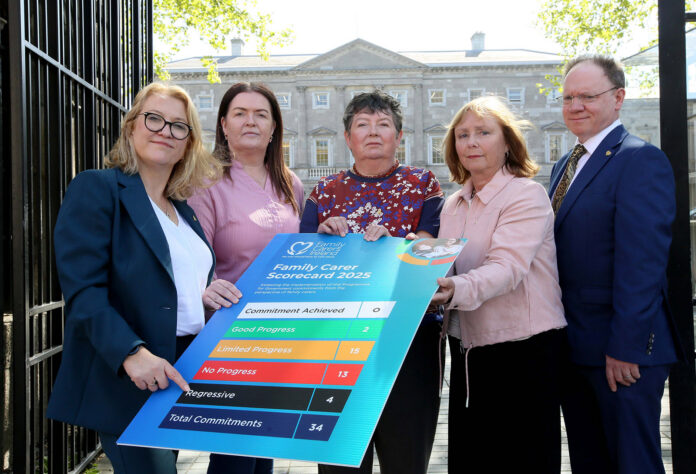
Government has failed to fully deliver on any of the 34 commitments made to family carers in the Programme for Government during its first year in office, according to Family Carers Ireland, who launched the ‘Family Carer Scorecard 2025’.
Assessed by the National Council of Family Carers, a body made up of elected delegates from local carer assemblies across Ireland, the scorecard also finds that four key areas have gone backwards. Of the 34 commitments examined: 0 were achieved; 2 showed good progress; 15 showed limited progress; 13 showed no progress and 4 were regressive.
The areas found to have worsened include access to Assessment of Need and specialist therapies, personal assistance hours, and the rollout of personalised budgets.
No progress was recorded on a number of major commitments, including support for family carers looking after more than one person, the introduction of a cost of disability payment, providing alternative respite options, delivering a statutory home care scheme, and reforming the no longer fit for purpose Disabled Drivers and Disabled Passengers Scheme.
The scorecard also found only limited progress on the Carer Guarantee, the Government commitment aimed at ensuring family carers can access a consistent minimum level of support regardless of where they live.
SOME PROGRESS
No additional funding was allocated in Budget 2026, leaving the annual allocation at €2.6m, even though Family Carers Ireland estimates that €5.6m is needed each year to fully fund it.
While the scorecard recorded good progress in two areas, progress towards abolishing the Carer’s Allowance means test and making special education placements and assessment mandatory for all trainee teachers, these were outweighed by delay and deterioration in other areas that have a direct impact on family carers’ daily lives.
Across Ireland, 624,190 people provide regular essential unpaid care. Yet many continue to face long delays, patchy services, and rising costs.
Sharon Foley, CEO, Family Carers Ireland, said that “too many families are still being forced to fight for assessments, therapies, services, and school places”, resulting in “a real human cost for children and families, and a far greater long-term cost for the State”.