

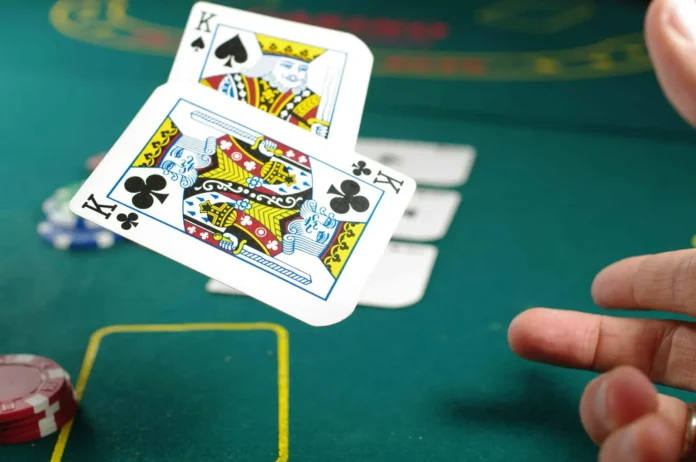
In casinos, there is a unique system of communication that helps visitors and staff understand one another without saying a word. This culture of gestures and specialised vocabulary has developed over decades. Familiarising yourself with it will be useful for those who prefer traditional venues, as well as fans of digital platforms, including privacy-focused no KYC casinos, where some of the terminology has made the leap from the real world to the virtual one.
Understanding the in-house jargon makes your leisure time more enjoyable and helps to avoid misunderstandings at the table. Below, we’ll break down the main signals, professional expressions and unspoken rules of conduct.
Why is non-verbal communication needed at the gaming table?
Gestures in poker, blackjack and other card games emerged for practical reasons. In a noisy room, one’s voice can easily be drowned out, whilst CCTV cameras require a clear record of every participant’s actions. Consequently, hand signals have become the standard, understood by croupiers and security staff alike.
The main advantages of this system are:
- Transparency. Every decision a player makes is unambiguously recorded by the surveillance equipment.
- Speed. The game flows more dynamically when players exchange brief signals.
- Protection against disputes. A video recording of a gesture resolves any disagreements about which action was chosen.
Gestures in blackjack
Blackjack is characterised by strict rules governing gestures. The dealer must be able to discern the player’s intention without verbal cues.
Basic signals
- Tapping the table with a finger — a request for another card (hit).
- Running the palm horizontally over the cards — standing (stand).
- Placing an additional chip next to the bet — doubling down (double down).
- Spreading two cards apart — splitting a pair (split).
These gestures are standard in most casinos worldwide. Once a beginner has mastered them, they will feel more confident right from their very first session.
Gestures in poker
The poker environment is rich in non-verbal cues, as psychology plays a key role here. Experienced players read their opponents’ micro-expressions.
Actions at the table
- Tapping the knuckles on the felt — checking.
- Pushing chips forward — placing a bet.
- Discarding cards face up — folding.
The concept of a ‘tell’
The term tell refers to an involuntary signal that reveals the strength of a hand. This could be a trembling of the fingers, a change in breathing or a sudden stillness. Professionals train to conceal such reactions whilst simultaneously spotting them in their opponents.
Glossary of common terms
The vocabulary of the gambling world is full of loanwords from English. Here is a list of the most frequently used expressions.
- Bankroll — the amount set aside exclusively for entertainment.
- All-in — betting all available chips.
- House edge — the casino’s mathematical advantage.
- Dealer — the staff member who deals the cards and runs the game.
- Cashout — withdrawing funds after a session has ended.
- Limit — the minimum or maximum bet size at a particular table.
Memorising this set of terms helps you get to grips with the rules more quickly and communicate with staff on an equal footing.
Staff signals: how to read a croupier’s behaviour
Staff also use their own system of signals. Hand gestures indicate to supervisors what has happened at the table.
Typical dealer actions:
- Clapping their hands before leaving — confirmation that their hands are empty, to dispel any suspicion of chip theft.
- Tapping the edge of the table when receiving a tip — a gesture of thanks to the guest.
- The ‘open palms’ gesture towards the camera — to confirm the integrity of the transaction during a count.
By observing these elements, guests gain a better understanding of the inner workings of the establishment and develop trust in the process.
Adapting terminology to the online environment
With the development of technology, many concepts have moved into the digital space. Virtual platforms have retained the familiar terminology whilst adding new layers of functionality.
What has changed online
- Game analytics has replaced intuitive observations of opponents. Modern services collect match statistics, helping users evaluate their own decisions.
- Online payments have simplified depositing and withdrawing funds. Transactions are completed in a matter of minutes via cards, e-wallets and cryptocurrency.
- Mobile entertainment has brought the tables to your smartphone. You can now play from anywhere with a connection.
When choosing a platform, it’s worth paying attention to the user-friendliness of the interface, the speed of financial transactions and the transparency of the rules. Platforms such as the one mentioned above emphasise simplified registration and the protection of personal data, which appeals to an audience that values privacy.
Practical tips for a comfortable gaming experience
To ensure your leisure time is enjoyable, it’s worth sticking to a few principles.
- Learn the hand signals in advance. Knowing the signals will save you from awkward pauses at the table.
- Set a budget. Decide on an amount that, if lost, won’t affect your financial well-being.
- Take breaks. Fatigue impairs concentration and the quality of your decisions.
- Analyse your sessions. Game analytics tools highlight weaknesses in your strategy.
- Check the platform’s reputation. Reviews and licences indicate the reliability of the service.
A combination of discipline and knowledge turns a visit to the casino into a mindful pastime.
Psychology at the gaming table
Understanding your own emotional state is just as important as knowing the terminology. The thrill of the game can distort your perception of reality, pushing you to take ill-considered steps.
Tips for self-control:
- Be aware of the moment when emotions start to take precedence over reason.
- Take losses in your stride — they are a natural part of the process.
- Do not try to recoup your losses immediately after an unlucky run.
A clear-headed view of what is happening protects both your wallet and your nerves.
Conclusion
The secret language of gambling establishments is a fascinating layer of culture, combining long-standing traditions with modern digital solutions. Mastering the gestures, professional vocabulary and staff signals makes any form of leisure more understandable and enjoyable. A sensible approach, attention to detail and prudent management of your funds help ensure you retain a positive experience of the process.
Disclaimer: Gambling is a form of entertainment, not a means of earning money. Approach it responsibly and treat your spending as the cost of leisure.
Age restriction: this content is intended for persons aged 18 and over (21+ in certain jurisdictions). If you feel that you are unable to control your gambling, seek help from relevant specialists.