
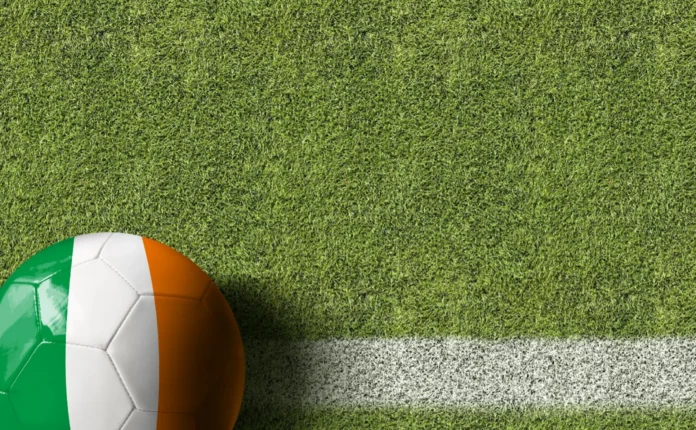
There’s a particular kind of football pain that comes not from being beaten, but from beating yourself. The Republic of Ireland know it well, and in the play-off semi-final in Prague, they felt every last bit of it.
Heimir Hallgrimsson’s side were the better team for long periods at the Fortuna Arena, led 2-0 against Czechia with the tie seemingly in hand, and still found a way to come home empty. For those already scanning the World Cup odds for this summer’s tournament, Ireland’s absence is not a surprise on paper. The manner of it, though, is a different conversation entirely.
Did Ireland simply run out of game management?
The lead was as comfortable as it looked. Troy Parrott converted from the spot in the 19th minute, his sixth goal in three Ireland appearances, before Matej Kovar’s own goal made it two. Czechia were rattled, and their fans were silenced.
Then Ryan Manning tugged Ladislav Krejci’s shirt inside the box, awarding Czechia a penalty that was simply not needed. Patrik Schick scored the penalty, and suddenly, a contest that Ireland had under control was alive again.
It’s tempting to call it misfortune, but it wasn’t. It was a lapse in concentration at the worst possible moment, and it changed everything. The argument that Heimir Hallgrimsson’s side froze after going 2-0 up, sitting back rather than pressing for a third, has real merit. Jayson Molumby hit the post, Parrott was denied by a fine Kovar save, and Ireland had the chances to kill the tie, but they didn’t take them.
The set-piece problem nobody solved
Ladislav Krejci’s 86th-minute equaliser was not a fluke. Czechia had scored more goals from set pieces than any other European nation in World Cup qualifying. That was known going in. Ireland’s defenders, who had been superb for large parts of the evening, switched off at exactly the wrong moment.
Krejci, their captain and a physically dominant defender, had a well-established record of arriving late into the box from dead-ball situations. Yet when the moment came, Ireland’s defensive shape broke down, and he headed home unchallenged at the near post.
It is fair to say that set pieces at this level are never fully solvable, and Czechia executed theirs well. But for a team that defended so resolutely for the majority of 90 minutes, conceding in that manner with four minutes left felt like a failure of concentration rather than a failure of quality.
The shootout curse – mentality or misfortune?
Ireland have now lost three consecutive competitive penalty shootouts, against Spain in 2002, Slovakia in 2020, and now Czechia. The pattern is hard to ignore.
What makes Prague particularly difficult to process is that Ireland were in the stronger position. Caoimhin Kelleher saved from Mojmir Chytil to give Ireland the advantage. Robbie Brady had scored coolly to make it 3-2. Everything pointed to Ireland going through.
Then Finn Azaz and Alan Browne both missed. Kovar saved both. Jan Kliment hammered home the winner.
Is this a mentality issue or simply the brutal randomness of a shootout? The honest answer is probably both. Elite penalty preparation is a science now, and clubs invest heavily in it. The question for Irish football is whether the national team infrastructure reflects that. Three shootout defeats across three decades suggests the conversation is overdue.
What now for Irish football?
Euro 2028 is on home soil. That tournament, hosted jointly by Ireland and the United Kingdom, represents the next genuine opportunity for a generation of players who are clearly good enough to compete at the highest level.
Parrott, still only 24, is emerging as one of the more reliable finishers in international football. Collins is a commanding presence. The squad has real quality. The argument isn’t about talent – it’s about whether the structure around that talent can deliver when the margins are this fine.
Prague showed both what Irish football is capable of and where it still falls short. The hope is that the hurt of this night becomes the foundation for something better. The fear is that it becomes another chapter in a very long book of near misses.