

For anyone new to the great game of rugby, or even for seasoned fans looking for a refresher, understanding the intricacies of each position is key to appreciating the full spectacle of a match. Rugby union is often celebrated as a sport for all shapes and sizes, and nowhere is this more evident than in the diverse roles and responsibilities of the 15 players on the pitch.
From the raw power of the front row to the blistering pace of the wingers, every player has a unique part to play in the complex tapestry of a rugby match. For more on the latest in the world of sports, you can always visit https://www.odd.ie.
The Forwards: The Engine Room
The eight forwards, often referred to as the “pack,” are the engine room of the team. Their primary role is to win and retain possession of the ball. They are typically the larger, more powerful players on the team, and their work in the scrums, rucks, and mauls is crucial to providing a platform for the backs to attack. The forwards are divided into the front row, second row, and back row.
- Front Row (Nos. 1, 2, 3): This consists of two props (loose-head and tight-head) and a hooker. The props provide the main pushing power in the scrum, while the hooker has the specialist role of “hooking” the ball back with their foot. The hooker is also usually responsible for throwing the ball into the lineout.
- Second Row (Nos. 4, 5): These are the locks, typically the tallest players on the team. Their main job is to provide power in the scrum and to be the primary jumpers in the lineout, competing to win the ball in the air.
- Back Row (Nos. 6, 7, 8): The back row, or loose forwards, consists of two flankers (blindside and openside) and a Number 8. These players are known for their high work rate, combining the power of the other forwards with the mobility of the backs. They are often the first to the breakdown, aiming to secure the ball or disrupt the opposition.
The Backs: The Finishers
The seven backs are generally the faster, more agile players who are responsible for scoring the majority of the team’s tries. They are positioned behind the forwards and their main role is to create and exploit space in the opposition’s defence.
- Half-Backs (Nos. 9, 10): The scrum-half is the link between the forwards and the backs, passing the ball away from the scrum, ruck, or maul. The fly-half is the team’s primary playmaker, a key decision-maker who will often dictate the attacking strategy through their passing and kicking game.
- Centres (Nos. 12, 13): The inside and outside centres are the heart of the backline’s defence and attack. They need to be strong runners, powerful tacklers, and have excellent handling skills to create opportunities for the wingers.
- Wings (Nos. 11, 14): The wingers are the fastest players on the team, positioned on the extremities of the field. Their main job is to finish off attacking moves by scoring tries in the corner.
- Full-Back (No. 15): The full-back is the last line of defence, positioned deep to field opposition kicks. They need to be reliable under the high ball and have a strong kicking game. They are also a key attacking weapon, often joining the backline to create an overlap.
Here is a summary of the positions:
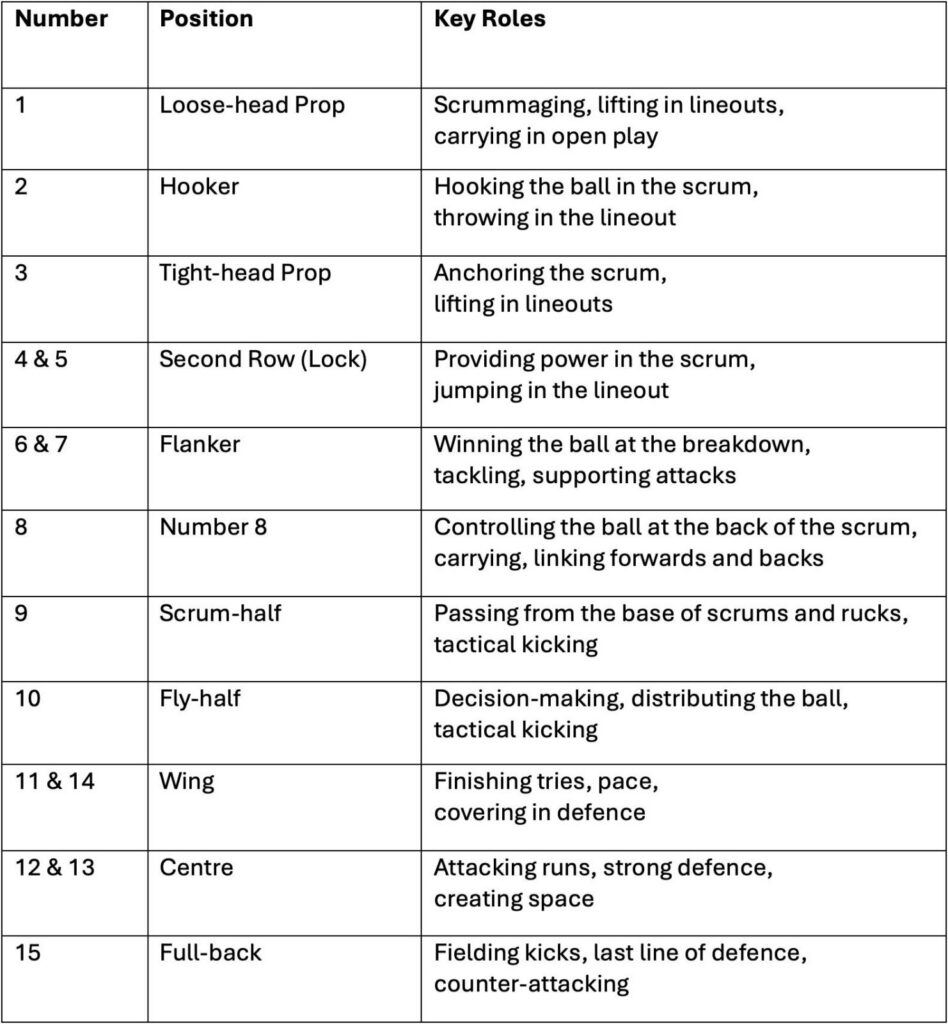
Each position requires a unique blend of skills, and it is the combination of these different talents that makes a rugby team successful. Whether you’re built for power or for pace, there’s a place for you on the rugby pitch. For more entertainment, you can check out the BoyleSports casino.