
You land in Dublin on a Thursday in late March, take the tram out to Ballsbridge, and walk into a livestock and horse show ground where 5,003 people have entered the same tournament. The queue for registration runs along a corridor built for agricultural exhibitions. Eighty-six nationalities are represented in the field. This is the Irish Open.
The scale of it surprises most visitors, because Ireland has a population of about 5 million and no obvious reason to host the largest event of its kind in Europe. The reason is historical, and it starts with one bookmaker who went to Las Vegas in 1980.
The Irish Open at the RDS
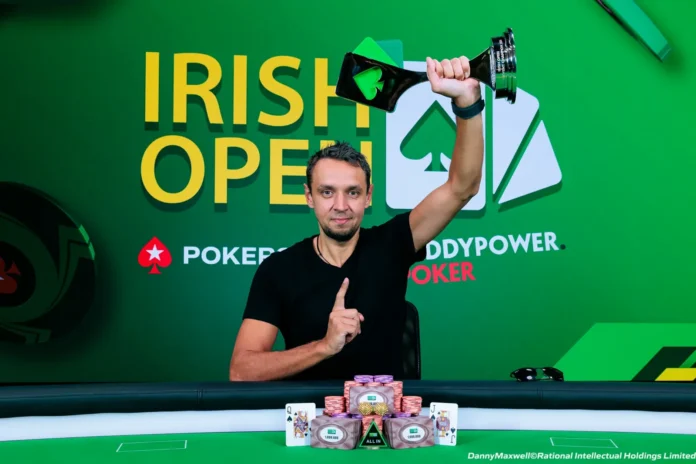
The 46th edition ran in Dublin from March 26 to April 6, 2026, at the Royal Dublin Society grounds. The Main Event drew 5,003 entries, a record for the tournament, and built a prize pool of €4,852,910. Players arrived from 86 countries. For comparison, a strong year for the same event a decade earlier produced a field closer to 1,000, so the growth is recent and steep.
Those numbers put it in a category that has only a handful of members in Europe. It is also the oldest no-limit event of its type outside Las Vegas, having run every year since 1980, which gives it something the newer festivals on the continent cannot manufacture. Organisers extended the brand internationally in 2026 with festivals in Sydney and Marrakech, and a United States stop is planned for 2027. That expansion is the clearest sign of how the event is now valued, since a tournament brand only travels when the name itself has become the product. The scheduling matters as much as the size. Running in late March puts the Irish Open ahead of the European summer calendar and well before the Las Vegas season, so it catches players looking for a first major date of the year, and it never has to compete with one already established.
Formats on the Irish Schedule
Nearly every headline event on the Irish calendar uses the same format, which keeps the schedule readable for a visiting player. Buy-ins move between €100 and €1,500, and the structures differ far more than the game does.
That consistency exists because Texas Hold’em games have been the default competitive format since the Irish Open began, and side events in Omaha or short deck fill the smaller rooms while the main stage stays with one game.
Origins in a Dublin Bookmaker’s Club
The event exists because of Terry Rogers, a Dublin bookmaker who traveled to Las Vegas in 1980, met the founder of the World Series and came home intending to build the same thing at a smaller scale. He ran the first Irish Open out of the Eccentric Club, a room above a pub at Hanlon’s Corner on the north side of the city.
Terry Rogers is a more interesting figure than the origin story usually allows. He changed Irish betting practice in the 1960s by introducing forecasts and multiple bets that had not been offered locally before. He finished second in the Alaskan Stakes in 1983 and fourth in the world at match play the following year. He also persuaded Noel Furlong to take up the game, and Furlong went on to win the World Series Main Event in 1999. A single Dublin club produced both the tournament and the country’s first world champion inside 20 years.
The Venue Itself
The Royal Dublin Society is an odd host for a card tournament and a practical one. Founded in 1731, it moved to Leinster House in 1814, sold that building to the Irish government in 1924 and relocated to Ballsbridge, the leafy south Dublin neighborhood where it had leased 15 acres from the Pembroke estate in 1879. The campus now covers 42 acres across Simmonscourt, Merrion Road and Anglesea Road.
The reason it works for a field of 5,000 is floor space. The RDS was built to hold the Dublin Horse Show and the Spring Show, which means large open halls with wide access doors and no fixed seating. A hotel ballroom in Dublin seats a few hundred players at most. Very few venues in the country can put 500 tables under one roof, and the ones that can were designed for cattle and show jumping.
The Winter and Spring Circuit
The Irish Open is one event on a calendar that runs most of the year. The 2026 schedule opened with the Galway Poker Festival from January 6 to 11 at a hotel on Galway Bay, followed by a one-day event in Limerick on January 24 with €30,000 guaranteed. The Munster Poker Festival ran from January 30 to February 2 with €100,000 guaranteed in its Main Event.
The format that draws the most attention is the €100 buy-in with €100,000 guaranteed, held in March at a hotel near the Dublin airport. A guarantee ten times the size of some fields’ total entries is a deliberate loss leader, and it fills rooms with players who would never enter a €1,000 event. That structure has done more to grow the domestic player base than any of the larger festivals. The pattern repeats across the smaller stops, where a low entry fee and a published guarantee bring in local players who then travel to the larger dates later in the year. Ireland has built a feeder system without ever formally designing one.
Killarney in September
The Killarney festival closes the year’s major dates and is the one most players describe as the best week of the calendar. The town has a permanent population of around 14,000 and absorbs a poker festival the way it absorbs everything else, which is by treating the whole thing as another September week.
Location explains most of the appeal. Killarney National Park surrounds the town with lakes and mountains, and cars are banned from most of the trails inside it. A player who busts on day one has the Ring of Kerry outside the door, which is not a consolation available in Ballsbridge.
Timing works in the festival’s favor as well. Anyone planning a trip to County Kerry in September will find the summer tour buses have thinned out while the hotels have not yet closed for the winter, so rooms are available at rates that would be impossible in July. The organizers did not pick the date for that reason, but it is why the week fills.
Back at the RDS
Return to that Thursday in March. The registration queue in the exhibition corridor is the visible part of a chain that starts with one bookmaker in a room above a pub, and every element of it is now measurable. There are 5,003 entries where the first field had a few dozen. There is €4,852,910 in a prize pool that began as a side pot in the Eccentric Club. The tournament outlived the man who started it by more than 25 years and now exports itself to Sydney and Marrakech. Ireland has no structural advantage in hosting any of this. The event is here because one bookmaker built it here in 1980, and 46 editions later nobody has found a reason to move it.