
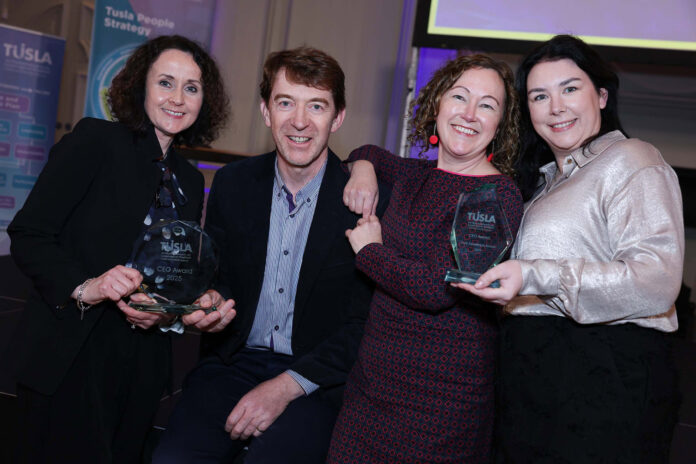
Tusla’s commitment to building an inclusive, empowered, and forward-thinking workforce was celebrated at this year’s Excellence and Innovation Awards, held at the Royal Hospital Kilmainham. In its third year, the annual ceremony once again shone a spotlight on the inspiring initiatives developed by staff across the Agency to deliver better outcomes for children and families throughout Ireland.
Among the standout winners this year was Barnahus Project – West and South, the leading European model of a child-friendly multidisciplinary interagency response for children and young people when there is a concern or disclosure of child sexual abuse.
Barnahus, which translates as ‘Children’s House’, has locations in Cork and Galway, and offers a coordinated interagency response by professionals from Tusla, HSE/Sexual Assault Treatment Unit (SATU)and An Garda Síochána to child sex abuse victims under the age of 18 years.
The Barnahus model is based on the principle that interagency collaboration at the earliest opportunity will improve outcomes for children who may have experienced sexual abuse. The process has the child’s safety and wellbeing at its core. Once there is an allegation of child sex abuse, Tusla social workers establish the safety of the child and then with the agreement from caregivers, refer the child to Barnahus.
NEW FACILITY BEING BUILT
Barnahus South currently serves Cork, Kerry, South Tipperary and Waterford working from existing locations in Cork city and Clonmel, until a new state-of-the-art building is built at St Mary’s Campus in Gurranabraher, which will allow all the services to be co-located in a child-friendly property.
Barnahus South manager, Fiona Geraghty, said research shows children must overcome substantial barriers to tell their story of sexual abuse.
“For some children the professional and criminal justice experience is often protracted, confusing and potentially a retraumatising experience, especially when there is a lack of interagency cooperation and collaboration,” she noted.
While Barnahus West is based in Galway and serves the Northwest, West and Midwest of Ireland.
COORDINATED RESPONSE
The Barnahus interagency team, which comprises Tusla child protection, HSE/SATU medical forensic, An Garda Síochána investigators, and Barnahus therapy practitioners, chaired by the Barnahus manager/team leader, with administrative support, meet within one week of the referral. They share the necessary information between agencies and agree a plan in the best interest of the child, while coordinating the interagency and intervention processes for the child.
Those children who attend for a specialist interview at Barnahus can meet jointly with social workers and gardaí who are specially trained to conduct forensic and developmentally appropriate interviews with children with the aim of eliciting as much detail as possible from the child about what happened to them in their own words.
The priorities are to minimise the number of times that the child is interviewed, reduce the trauma for the child and uphold the child’s rights to the criminal justice system. Their account is often the strongest evidence in criminal investigations and can also inform the child protection, medical and therapeutic assessment when shared with the wider interagency team.
Tusla’s Chief Social Worker, Ger Brophy, says Barnahus is child-centred model which makes the reporting process easier for the child.
“Barnahus was delighted to receive the CEO’s Tusla Excellence Award. Barnahus is a real team effort with the co-ordinated input of the HSE/SATU and An Garda Síochána. We also will have Children’s Health Ireland in one centre soon to be opened. It’s a simple idea to have a ‘Child’s house’, it is not a Tusla or HSE or AGS house but a house where the child is the centre,” he said.
“Barnahus West in Galway is showing the way. It is built with the child in mind, with low lighting and a warm, welcoming atmosphere. The process is trauma informed and staff are specially attuned to the needs of the child with rooms that allow space for the child to centre themselves or take a break when the child needs it.
“This award recognises the hard work of so many Tusla staff over the past years and current staff who are showing excellence and expertise in supporting children and families. We are thrilled to be recognised in this way.”
Among the core principles of Barnahus are avoiding undue delays, reducing secondary trauma, and ensuring the child’s best interest. Open communication is key for the best interest of the child, Ms Geraghty says.
See www.barnahus.ie for more information.