

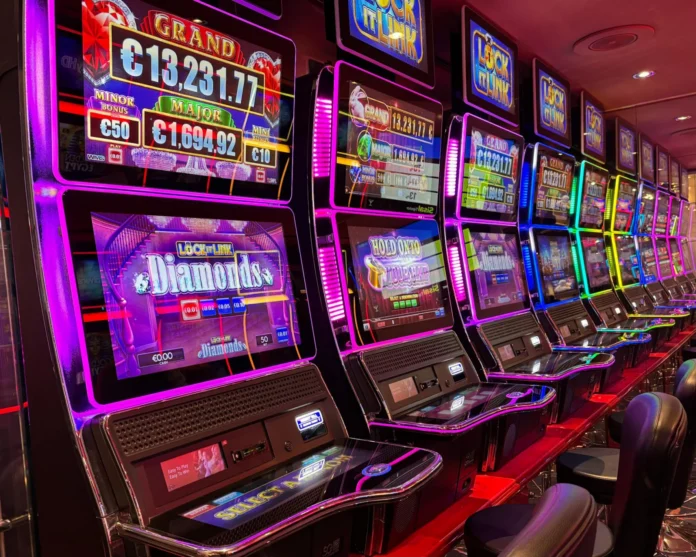
Vibrant reels, dramatic sounds and smooth spins create the impression of a simple and straightforward game. But take a look under the bonnet, and you’ll discover a complex engineering structure where mathematics, programming and design all come together. A single spin sets off a chain of processes that most users are completely unaware of. For those choosing a platform — for example, checking for a Curacao online casino license — it is useful to understand what lies behind the attractive façade. Let’s take a look inside the machine.
The anatomy of a slot: the visible part
Let’s start with what the user sees on the screen. The outer layer of the slot machine consists of graphics, animation and sound effects. These elements create the atmosphere and hold the player’s attention, but have no direct bearing on the outcome.
What makes up the visual interface:
- Reels and symbols — the basis of the playing field.
- Spin animation — the effect of movement and stopping.
- Sound design — music and event sounds.
- Control interface — bet and line buttons.
Random number generator: the heart of the mechanism
Hidden beneath the beautiful graphics lies the main component — the random number generator, or RNG. It is this programme that determines which symbols will land on the reels. The algorithm runs continuously, generating thousands of values per second, even when the slot machine is idle.
The moment the button is pressed
When a player starts a spin, the system records the generator’s current value at that split second. This determines the outcome. All subsequent animation is merely a visualisation of a result that has already been determined. Sound game analytics confirms that the image simply displays a pre-calculated result.
The independence of each spin
The most important property of an RNG is the absence of memory. Each spin is not linked to previous ones and does not depend on them. The reels do not ‘build up’ a win nor do they ‘remember’ losing streaks.
Symbols and their distribution
Behind the apparent chaos of symbols lies a well-thought-out mathematical model. Each symbol has a set frequency of appearance, which is hard-coded. Rare symbols appear less frequently precisely because there are fewer of them on the virtual reel.
How the distribution works:
- Virtual reels contain a set of symbols.
- The frequency of each symbol is determined by the developer.
- High-value symbols appear less frequently than standard ones.
- Combinations are calculated according to fixed rules.
The Return to Player (RTP) and what it means
The key parameter of any slot is the RTP, or Return to Player. This figure shows what proportion of all bets is theoretically returned to players as winnings over the long term. With an RTP of 96%, the house edge is 4%.
What is important to understand about the return:
- Long-term calculation — the figure is based on millions of spins.
- No guarantee for a single session — individual games can vary significantly.
- Differences between slots — each slot machine has its own value.
- Connection to mathematics — the RTP is hard-coded and cannot be changed by the casino.
Volatility: the nature of the slot
As well as RTP, slots differ in terms of volatility. This parameter describes how payouts are distributed over time. It determines the style of play and suits different preferences.
Main types of volatility:
- Low — frequent but small wins.
- Medium — a balance between size and frequency.
- High — rare but large payouts.
Additional mechanics and features
Modern slots offer a host of special features. Bonus rounds, free spins and special symbols add complexity to the game, but do not alter its random nature. All of these are also controlled by a random number generator.
Common mechanics:
- Wild symbols, which substitute for other symbols.
- Scatters, which trigger bonus rounds.
- Free spins with additional conditions.
- Multipliers, which increase the payout amount.
Technology and accessibility
The development of mobile entertainment has made slots equally accessible on both computers and smartphones — the maths remains unchanged regardless of the device. Convenient online payment methods speed up account transactions, but have no influence whatsoever on the operation of the generator or the generation of outcomes. Licensed software undergoes independent audits, guaranteeing the fairness of the algorithm.
How to apply this knowledge in practice
Understanding how a slot works helps you play with awareness. A few practical tips:
- Check the stated RTP before you start playing.
- Choose a volatility level that suits your style and budget.
- Remember that each spin is independent of previous ones.
- Don’t believe in ‘hot’ or ‘cold’ slots.
- Treat bonus features as part of the entertainment.
Conclusion
An online slot is a complex system where the visual interface hides a rigorous mathematical foundation. The random number generator determines the outcome the moment the button is pressed, whilst the animation merely displays the result. Understanding these inner workings dispels the myths about ‘hot’ slots and allows you to approach the game with a clear head, treating it as entertainment with transparent and fair rules.
Gambling is a form of entertainment, not a way to make money. This content is intended for persons aged 18 and over (18+). Please gamble responsibly.