

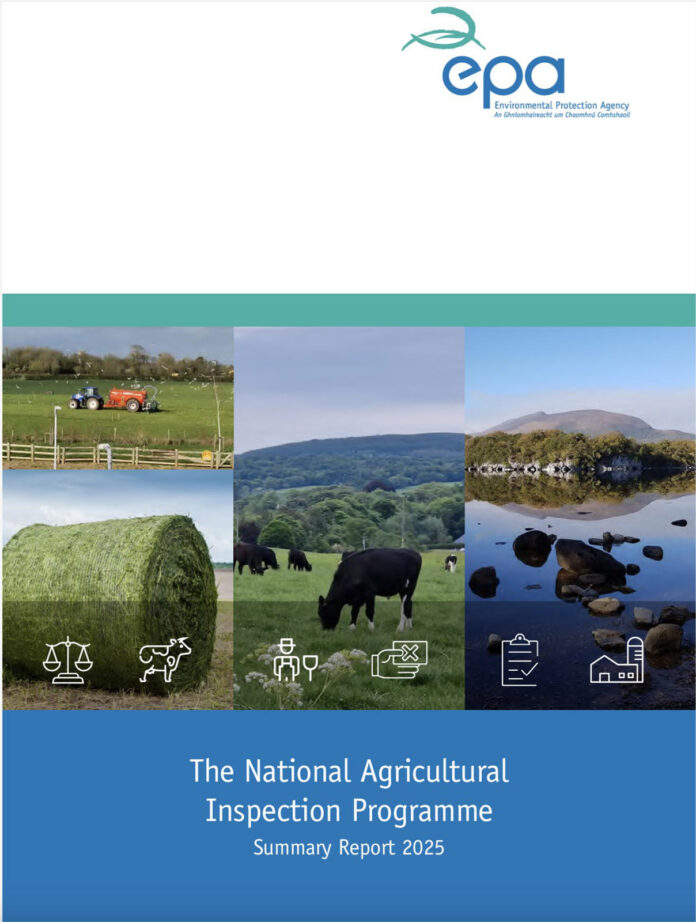
The Environmental Protection Agency (EPA) this week released The National Agricultural Inspection Programme (NAIP) report which details farm inspections completed by local authorities in 2025. The NAIP aims to achieve higher levels of compliance and strengthen enforcement with the Good Agricultural Practice for Protection of Waters Regulations and in doing so, reduce the impacts of agricultural activity on water quality.
The EPA has set inspection targets for each local authority under the NAIP, which prioritises areas where agricultural activity poses the greatest risk to water quality. In 2025, 4,315 farms were inspected by local authorities, which is 96% of the annual target of 4,500 set by the EPA.
These inspections found a non-compliance rate of 43% due to poor farming practices or management. Some oft he main reasons for non-compliance include uncontrolled runoff from farmyard manure; inadequate management of silage pits; silage effluent discharging to groundwater; clean water not properly segregated and soiled water not properly managed; inadequate storage capacity and also, inadequate management and control of slurry.
Poor farming management practices can pollute rivers, streams and coastal waters through the release of nutrients, such as nitrogen and phosphorous. Harmful pathogens and nitrates may also pose a risk to human health through contamination of drinking water wells and/or abstraction sources.
FOLLOW-UP INSPECTIONS
Commenting on the report, Dr Tom Ryan, Director of the EPA’s Office of Environmental Enforcement said the non-compliance remains too high.
“The significant increase in the number of farm inspections carried out by local authorities in 2025 is welcomed. Agriculture remains a significant pressure on our water quality and the non-compliance rate found during inspections remains too high. Farm compliance with the Good Agricultural Practice for Protection of Waters Regulations is essential to protecting and improving water quality. In addition, a more consistent and sustained enforcement effort is needed across all local authorities to ensure full compliance with these regulations and to protect public health and the environment.”
Follow-up inspections by local authorities are critical to ensure that non-compliances are remediated. In addition, non-compliant farmers may be subject to enforcement actions which may result in a penalty to their Basic Income Support for Sustainability (BISS) Scheme payments, a prosecution or a combination of both. A total of 2,935 enforcement actions were taken by local authorities in 2025.
Ray Cullinane, Acting Programme Manager, Office of Environmental Enforcement said “Local authorities must sustain the increased level of farm-inspection activity achieved in 2025. To address the high non-compliance rate, local authorities should increase follow-up inspections to close out outstanding cases and ensure full compliance with the relevant Regulations. In parallel, local authorities, advisory services and industry stakeholders must also strengthen compliance-promotion and awareness-raising activities to support farmers in meeting their regulatory obligations”.
The National Agricultural Inspection Programme Summary Report 2025 is available on the EPA website.