

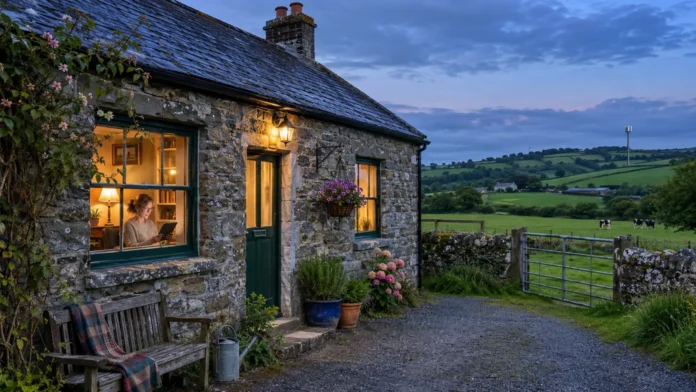
The most convincing demonstration of better broadband rarely involves a speed test. It is the evening when a film starts without a pause, someone upstairs joins a video call and nobody has to negotiate whose device gets priority. For rural households, that ordinary moment can say more than a headline connection speed.
Better broadband is changing what an evening at home can offer. Alongside films and music, live casino games bring a more interactive experience to the screen, with real dealers hosting games as they unfold. For adults exploring Ireland casino online options, Casino Kings offers live blackjack and roulette that illustrate why connection quality matters: a continuous video feed is central to the experience, particularly when other people in the house are streaming too.
The infrastructure reaches the front door
National Broadband Ireland said in February 2026 that more than 450,000 homes, farms and businesses were ready to connect under the National Broadband Plan. Its NBI update also recorded more than 164,000 connections.
For communities across north Cork and neighbouring counties, that is a useful way to judge progress. The question is increasingly what a connection allows a household to do comfortably, rather than whether a particular address appears inside a coverage area. A home office and a sitting room may be sharing the same line, but they place different demands on it at different hours.
There is already a substantial audience for these services. The CSO’s household survey found that 87% of households had fixed broadband in 2025. That national figure does not describe every lane or townland. It does, however, show how thoroughly a dependable internet connection has become part of the equipment of an Irish home.
An evening with more than one audience
The old idea of a household gathering around a single television has plenty of life left in it. It also sits alongside a more varied reality: one person follows a match, another catches up on a programme and somebody else listens to an audiobook. Better connectivity makes those choices easier to accommodate under one roof.
That does not mean every screen needs to be running constantly. It means an evening can be organised around people’s preferences rather than a temperamental connection. Downloading a programme before travelling, catching a local broadcast after work or calling relatives abroad becomes less of a technical undertaking.
There are still practical decisions after installation. A router tucked behind a thick stone wall may struggle to reach the far end of a house. Older devices can also limit what a new connection appears to deliver. Looking at the rooms where people actually use their devices can be more helpful than repeatedly measuring performance beside the router.
Broadband announcements naturally concentrate on construction, investment and coverage. The household story is quieter. It is about a rural address gaining more of the everyday flexibility already expected elsewhere, while keeping the familiar pleasures of an evening at home. That is where the rollout becomes something people can feel. That makes everyday reliability a meaningful measure of progress.