

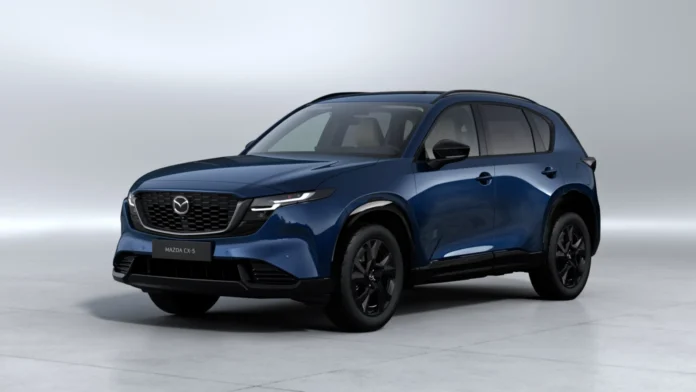
Mazda continues to build on the success of its global best-seller, the all-new Mazda CX-51, showcasing an evolved Kodo design approach and introducing a striking new exterior colour: Navy Blue. Subtle yet confident, the new blue reinforces the CX-5’s refined character as a versatile SUV, crafted with a Japanese soul and designed to resonate emotionally with modern lifestyles.
New Navy Blue: A Refined Expression of Colour
A palette of eight exterior colours is available for the all-new Mazda CX-5, including a new Navy Blue introduced for the first time in the Mazda line-up. While Mazda is often associated with red, blue has played a defining role in the brand’s history for decades: from the R360 Coupe to iconic models such as the Familia and MX-5. With more than 150 “blue” shades, Navy Blue builds on Mazda’s legacy as a colour designed to feel timeless, emotional, and globally appealing.
“The all-new CX-5 evolves an instantly recognisable design with greater confidence and versatility. Navy Blue was chosen to naturally enhance its Kodo surfaces – a colour that strengthens the design’s presence while feeling familiar, refined and easy to live with”, explains Jo Stenuit, European Design Director at Mazda.
Mazda’s new colour was developed through a collaborative co-creation process between Mazda’s regional design, development and production engineering teams. Advanced digital and model-based development methods were used to precisely translate the designers’ vision into a production-ready finish.
“We follow a co-creation approach with our colleagues in Japan when developing new exterior colours. This means sharing proposals both digitally and physically, exchanging feedback from both sides and gradually narrowing down the most suitable shades for upcoming model years. This process guided the development of Navy Blue for the CX-5, and we are already applying the same approach for future colour generations”, explains Alena Gersonde, colour and material senior designer at Mazda’s European R&D Centre.
The goal was to create a new standard blue to outperform Mazda’s popular Deep Crystal Blue, balancing multiple types of mica2: combining mica selected for brightness with mica optimised for colour development. The result is a high-resolution appearance with strong contrast, vivid and expressive in bright sunlight, yet deep and elegant under cloudy skies or at night.
Familiar, Yet Evolved Design
The all-new Mazda CX-5 retains the iconic shape that has defined the model since its debut in 2012, while further advancing Mazda’s Kodo – Soul of Motion design language. Instantly recognisable, the latest generation gains a more confident presence, with the new Navy Blue emphasising its sculpted surfaces and refined proportions.
Developed under the design concept “Wearable Gear”, the all-new CX-5 is designed to fit naturally into a wide range of lifestyles. Like functional, well-designed clothing, it balances style, comfort, and practicality equally in urban environments and more adventurous settings. This philosophy also guided the development of Navy Blue as a versatile and emotionally resonant colour choice.
Confident Design, Everyday Practicality
The CX-5’s design evolution emphasises a grounded stance and visual stability, achieved through muscular wheel arches, a raised front and a wider track. New linear LED lighting graphics and bold MAZDA lettering at the rear create a stronger, more modern visual impact. Inside, the all-new Mazda CX-5 reflects the Japanese principle of Ma, creating a clean, spacious and functional cabin, ideal for family use and long journeys alike.
1 All-new Mazda CX-5 2.5 e-Skyactiv G (FWD): Fuel consumption: 7.0 l/100 km; CO₂ emissions: 157–159 g/km (WLTP combined); CO₂ class: F.
All-new Mazda CX-5 2.5 e-Skyactiv G (AWD): Fuel consumption: 7.4–7.5 l/100 km; CO₂ emissions: 168–169 g/km (WLTP combined); CO₂ class: F.
2 As types of paint using reflective materials, there are “metallic paint,” which mixes in metal flakes such as aluminum, and “mica paint,” which mixes in mica flakes.